

Latest energy price cap highlights need for
more support for off-grid rural households
27 August 2026
Rural families whose homes are not connected to the gas grid must not be forgotten as the government considers new packages of support to ease the burden of rising energy prices amid the ongoing cost-of-living crisis.
In response to the latest energy price cap increase – which was announced by the regulator Ofgem on 26 August, ahead of its introduction on 1 October – ministers have pledged extra support to help families cope with the four per cent rise to average annual bills.
Miatta Fahnbulleh MP, Secretary of State for Energy Security and Net Zero, told the Guardian newspaper the government would “keep looking at what more we can do to protect families from unaffordable bills.”
Action with Communities in Rural England is calling on the government to ensure that additional support is also put in place for rural households off the gas grid, including heating oil users, whose energy costs have increased much more significantly than the energy price cap in recent months.
The issue
The announcement by Ofgem will provide some level of certainty for energy consumers who are on the gas grid.
Unfortunately, rural energy customers who are off the gas grid, and who have to use heating oil, or other alternative fuel sources like Liquified Petroleum Gas (LPG), do not have this certainty.
The price of heating oil doubled in March when the war in the Middle East broke out, and is still nearly 40 per cent above its pre-war levels.
The market for heating oil works very different to electricity and gas.
Households order as they need to refill their tanks, from local or regional distributors who deliver it by tanker to their homes. Consumers are not protected from sudden price rises and the market is not regulated.
As shown in the graph below, the price of heating oil more than doubled in early March 2026, resulting in a typical 1,000 litre order increasing by £740 in a week (Boilerjuice.com).
After falling slowly between April and the end of June, the price has risen significantly again since early July, following the collapse of the ceasefire between the USA and Iran.
After peaking at 92p per litre on 25 July, by 26 August it was 85 pence per litre – 38 per cent above the pre-war price.
These price increases are impossible to predict as they are linked to international diplomacy, but we do know the stakes will get higher as winter approaches and global demand for energy increases.
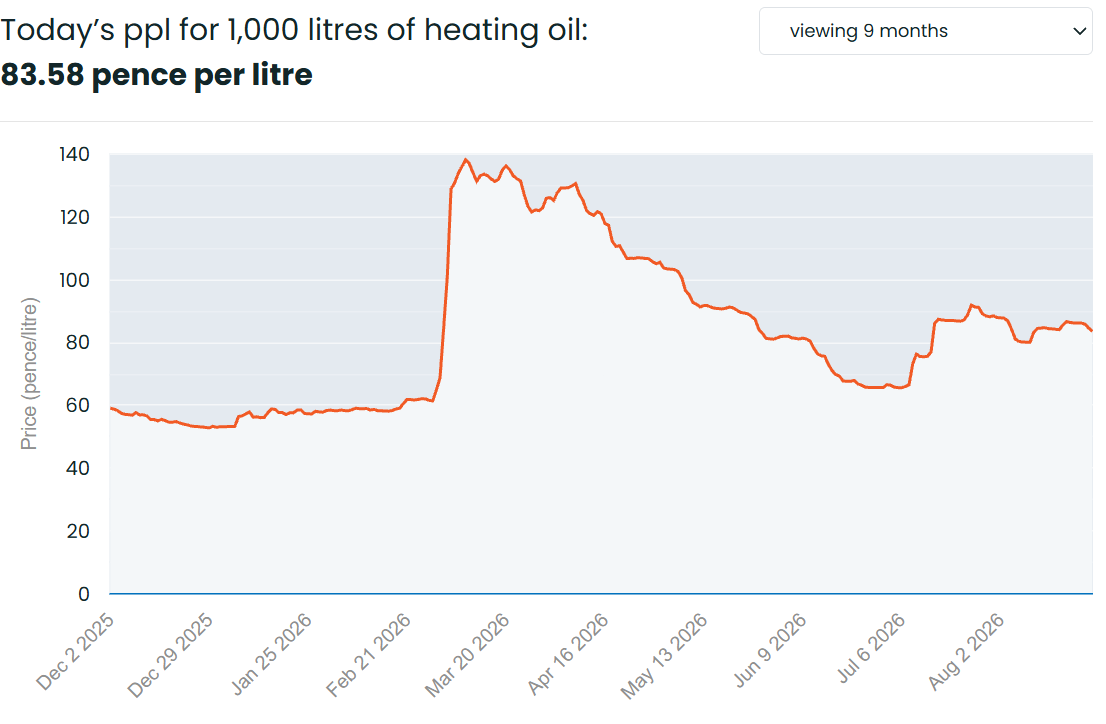
Heating oil prices for the last nine months. Source: boilerjuice.com
There is no price cap for rural consumers who are off the gas grid and use heating oil or LPG, unlike those who are on the gas grid who have benefitted from a price cap since 2019.
The problem is further exacerbated because heating oil must be bought in bulk.
The heating oil market is generally seen to be competitive but it does not insulate consumers from extreme price fluctuations due to international events.
As a result, rural communities are exposed to global price increases for an essential household product which, as we have seen this year and on previous occasions, can change dramatically within 48 hours.
This is one of the reasons why the Competition and Markets Authority’s recent market study has recommended the introduction of a proportionate regulatory regime for the heating oil market.
Price fluctuations on this scale have a major impact on the cost of living for low and middle income rural households.
Heating oil sales have dropped since March compared to previous years, as households have delayed buying fuel in the hope prices will fall, but they are still 30 per cent higher in late August than early July, and there is no way to predict what will happen next.
In addition, there are real issues of inequity as households on the gas grid, which are usually urban or suburban homes, do not face these challenges.
How can the government help rural communities?
The government announced in March that it would expand its Crisis and Resilience Fund to help the most vulnerable low-income families with the rising cost of heating oil.
An additional £52 million was made available across the UK, with £27 million of that dedicated to households in England.
The scheme was implemented differently across each local authority in England and no official data is available to indicate how successful this fund has been.
Since March, no other measures have been announced in preparation for the autumn, although we await the government’s response to the recommendations of the Competition and Markets Authority’s market study on heating oil.
As the country’s only charity speaking up for rural communities as a whole, ACRE would like to see the government expand its support to ensure that all heating oil users are helped to refill their tanks this autumn.
This would ideally have a similar impact to the energy price cap.
The increase in costs of up to several hundred pounds per order is an issue for low and middle income homes – not just the most vulnerable.
ACRE has already submitted several policy ideas to the government since the war broke out in February.
One option which could provide some limited breathing room would be to remove the current five per cent VAT on heating oil purchases.
This would not compensate for the full price rise but would be valuable help.
A similar move was taken by the government in July 2026 when it announced the five per cent tax on domestic electricity bills would be removed for an initial six-month period.
Removing heating oil VAT for the same period – between October 2026 and March 2027 – could be paid for out of the billions raised each year via the Energy Profits Levy, which is effectively a tax on the windfall profits of the UK operations of large energy companies.
Corinne Pluchino, Chief Executive at ACRE, said: “We are facing a rural cost of living crisis for energy – an essential item for every household.
“ACRE remains keen to work with the government on any initiatives that can help rural families keep energy costs down this winter.
“With the approach of colder weather, there is now a very real and pressing need to take decisions, and reassure rural people that they have not been forgotten.
“In the longer term we would welcome the opportunity to work with government to develop a structured plan to help rural households switch to longer-lasting, more sustainable solutions, such as heat pumps and other renewable energy alternatives.
“ACRE can draw on the expertise of our network of 37 member charities who have practical experience of supporting rural communities to make these changes on the ground.”
“But the immediate priority is the cost of living crisis in rural homes this winter. We hope the government will be in a position to make a positive announcement very soon.”
More information about the work of ACRE can be found online at www.acre.org.uk.

“We are facing a rural cost of living crisis for energy,
an essential
item for every household.”
Corinne Pluchino,
Chief Executive, ACRE